
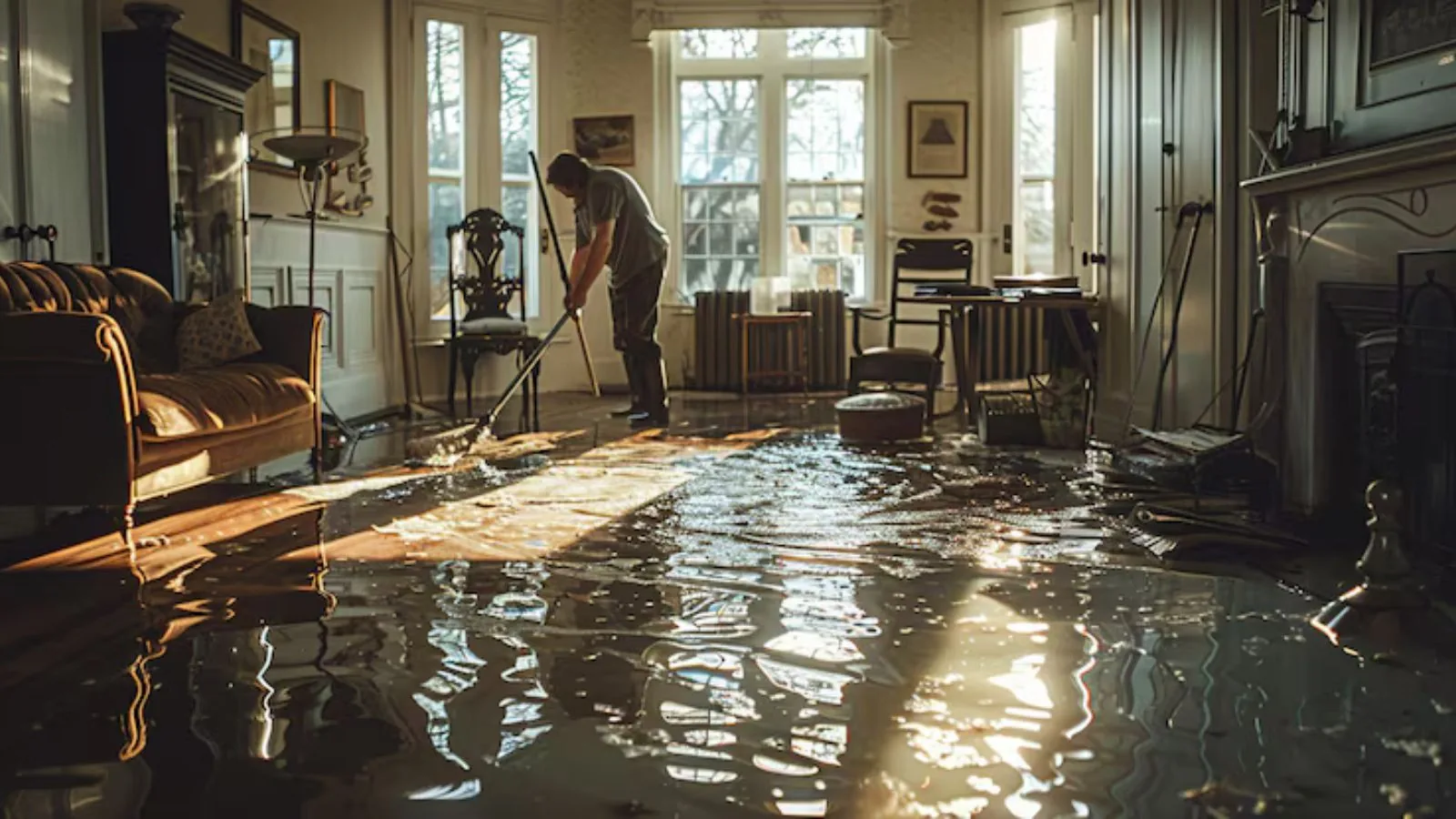
Small spills and short leaks can be handled by a homeowner with towels, a wet vacuum and fans. Larger or dirtier losses cannot, because water hides in walls, pad and subfloor and the damage keeps growing after the surface looks dry.
This guide covers what you can do safely, what you should leave to a crew and how to tell the difference.
Start with safety
Before touching anything wet, check for electrical hazards. Do not stand in water near outlets, power strips or appliances. If water is near the panel, stay out and call the utility or 911. Turn off power to the affected room only if you can reach the breaker while standing on a dry surface.
Know the water source. Clean supply water from a pipe is one thing. Water from a sewer line, a dirty floor drain or a flooded yard is another, and it should not be cleaned up with household products. See the sewage backup cleanup page if that is your situation.
Stop the source, then remove standing water
Shut off the main or the nearest valve. Then remove standing water with a wet vacuum, a mop and buckets, or a submersible pump for deeper water. Work from the doorway inward so you are not walking through wet areas more than needed.
Wet carpet and pad hold more water than they show. Lift the carpet edge and press on the pad to see how wet it is. If water squeezes out, professional extraction will do more than a household vacuum. The water extraction page explains how.
Not Sure How Far It Spread?
Call the 24/7 line and describe what you see.
What to remove and what to save
| Item | Usual approach | Why |
|---|---|---|
| Wet carpet pad | Remove and discard | It holds water and is inexpensive to replace |
| Carpet (clean water, caught fast) | Often lifted and dried | The fibers can recover if the subfloor dries |
| Wet drywall at the baseboard | Cut out if soft or stained | It wicks water upward and can stay wet inside |
| Wet insulation | Remove | It holds water against framing for a long time |
| Solid wood furniture | Dry and clean | It is usually worth saving if it is not contaminated |
| Particleboard furniture | Often discarded | It swells and does not recover |
| Paper, books, cardboard | Dry quickly or discard | They absorb water and degrade |
Dry the space
Open windows when the air outside is drier than inside. Run fans to move air across wet surfaces, and run a dehumidifier if you have one. Do not run the heat on wet carpet, since warm moist air only moves the moisture around.
Drying a house needs more than the surface to feel dry. Moisture meters read what the eye cannot see. If you do not own one, a restoration crew will bring meters and equipment designed to dry the structure to a standard. See the structural drying page.
Check the space the next day. If a wall still feels cool or damp, or if a musty smell starts, there is more water than the surface shows.
Clean and sanitize the right way
Once surfaces are dry, wash hard surfaces with a household cleaner and warm water. Items touched by clean water can usually be cleaned this way. Items touched by contaminated water need a professional approach and, often, disposal.
Avoid mixing cleaning products. Some combinations release harmful fumes. Wear gloves, and ventilate the room while you work.
Madera details that affect your cleanup
The Fresno River passes north of downtown Madera. The Madera Irrigation District reported in 2023 that releases from Hensley Lake into the river were 2,500 cubic feet per second during a period of expected high runoff, and it warned that breaks can occur on properties next to streams and creeks.
If your water came from outside, keep in mind that river and slough water can carry soil and debris. Treat it as contaminated until a professional says otherwise.
The City of Madera tells residents to put only rainwater down storm drains and to clear leaves and debris, since clogged drains can contribute to flooded streets during storm events. Clearing the drain near your property before a storm is a simple step.
Near Chowchilla, the Madera County Sheriff issued a pre-evacuation advisory in 2017 for residents along Berenda Slough after Chowchilla Water District officials expected flows to rise, so slough water is a real local source to treat as contaminated.
When to stop and call a crew
- Water has been in the home for more than a day
- The water came from a sewer, a drain or outside
- Ceilings sag or walls feel wet above the baseboard
- More than one room is wet
- You smell mustiness that returns after cleaning
- You cannot get readings to match a dry room
Any one of these means the water has gone beyond a towel and fan job. Call (559) 597-1434 and the 24/7 line can start the conversation about scope and price before work begins.
Water Damage Cleanup Questions in Madera
Can I dry a wet carpet myself?
Small clean-water spills on carpet can often be handled with extraction and fans. If the pad stayed wet or the water was dirty, a crew does a more reliable job.
How soon should I start cleaning up?
As soon as it is safe. Water can spread through materials within hours, and delay increases how much has to be removed.
Do I need to wear protective gear?
Gloves and boots are a good idea for any wet cleanup. For sewage or flood water, crews use more protection and homeowners should not do the work.
Does the City of Madera help clean up water inside a home?
No. The City handles the public water and sewer systems and storm drains. Cleanup inside your property is the owner's responsibility, though the City takes reports of leaks and blockages on its side of the meter.